
 English
 Spain
Spain
![Tutankhamun Tomb: Inside the Discovery, Treasures, and Lasting Legacy [Updated 2025]](https://egyptselecttours.com/storage/5145/conversions/pexels-photo-16386720-webp.webp "Tutankhamun Tomb: Inside the Discovery, Treasures, and Lasting Legacy [Updated 2025]")
Tutankhamun Tomb: Inside the Discovery, Treasures, and Lasting Legacy [Updated 2025]
Nothing stirs the imagination quite like the discovery of Tutankhamun’s tomb. Hidden for over 3,000 years, its unveiling in 1922 rocked the world and changed what we know about ancient Egypt almost overnight.
From sparkling golden treasures to perfectly preserved artifacts, the tomb showed us a rare glimpse of royal life from long ago. The significance of this find goes far beyond its beauty—experts still study its mysteries, and every detail adds to our understanding of Egypt’s rich history.
Today, Tutankhamun’s tomb stands as one of archaeology’s most important discoveries, telling a story that continues to surprise and inspire.
The Discovery of Tutankhamun’s Tomb
The story behind Tutankhamun’s tomb reads like a classic adventure. By the early 1900s, most royal tombs in Egypt’s Valley of the Kings had already been discovered and raided. Some experts even thought every significant find had already been made. It took years of tireless effort—plus a bit of luck—to finally uncover the untouched resting place of Egypt’s boy king. The people involved, their patience, and the moment they chipped open the tomb’s doorway have become legendary in the world of archaeology.
Howard Carter and Lord Carnarvon
Howard Carter wasn’t the first to dig in the Valley of the Kings, but he was one of the most determined. He teamed up with Lord Carnarvon, a wealthy British aristocrat who had a love for history and the means to fund large projects. At a time when most were ready to call the search off, Carter convinced Carnarvon to give him just one more season.
Their partnership was built on trust and shared excitement for possible discovery. Carter brought expert skills and stubborn persistence, while Lord Carnarvon offered the finance and encouragement to keep the work going. For years, this team sifted through dust and debris. Time after time, they found only shards and empty chambers. The valley, already stripped by tomb robbers centuries earlier, seemed to offer nothing new.
Yet Carter kept at it, moving carefully and methodically. In 1922, just as their money was about to run out, Carter’s team noticed a stone step beneath an old workman’s hut. What followed would make history. After more digging, they found a sealed doorway, still plastered and marked with the official stamp of Tutankhamun.
Unveiling the Sealed Tomb
When Carter and his crew finally opened the tomb’s entrance, the world was waiting. On November 26, 1922, Carter made a small hole in the doorway and peered inside. The sight took his breath away. In the flickering light, golden statues, furniture, and chests stacked to the ceiling became visible for the first time in thousands of years.
This first room, called the antechamber, was a mess of dazzling treasures packed closely together. Objects included:
- Large gilded couches shaped like animals
- Chariots stacked neatly
- A pair of black guardian statues
- Ornate trunks and everyday items for the afterlife
Despite the clutter, almost everything was intact. Unlike other tombs that had been emptied by thieves, this space felt frozen in time. Word of the discovery spread quickly. Reporters rushed to the site, and Carter’s patient work became a symbol of hope and wonder for people around the globe. The boy king’s tomb had finally been found, and its riches were just beginning to be revealed.
Inside the Tomb: Layout and Major Findings
Tutankhamun’s tomb offers a true time capsule into ancient Egyptian royalty. Every detail, from its rooms to the items left behind, tells stories about life, death, and belief in the afterlife. Let’s walk through the layout and spotlight the most breathtaking finds, including the golden mask and treasures that still awe visitors and scholars alike.
Antechamber, Annex, and Burial Chamber: Function and Notable Objects
The tomb is made up of four main spaces, each packed with history and meaning. They’re smaller than some pharaohs’ tombs, but what these rooms hold matters more than their size.
- Antechamber:
This was the first room Carter and his team entered. It was crammed with beds shaped like animals, chariots ready for a race, richly painted trunks, and tables stacked with food for the afterlife. No murals cover the walls here, but the objects say enough about a king prepared for eternity. Among the surprises were three gilded couches and elegant everyday items, a peek at royal comfort. - Annex:
Off to the side, the annex served as a storage area. It looked like a storeroom in disarray, where jars, oils, and baskets competed for space with board games, wine, and rare perfumes. Many items, scattered as if hurriedly left, were intended to nourish and entertain the king beyond death. - Burial Chamber:
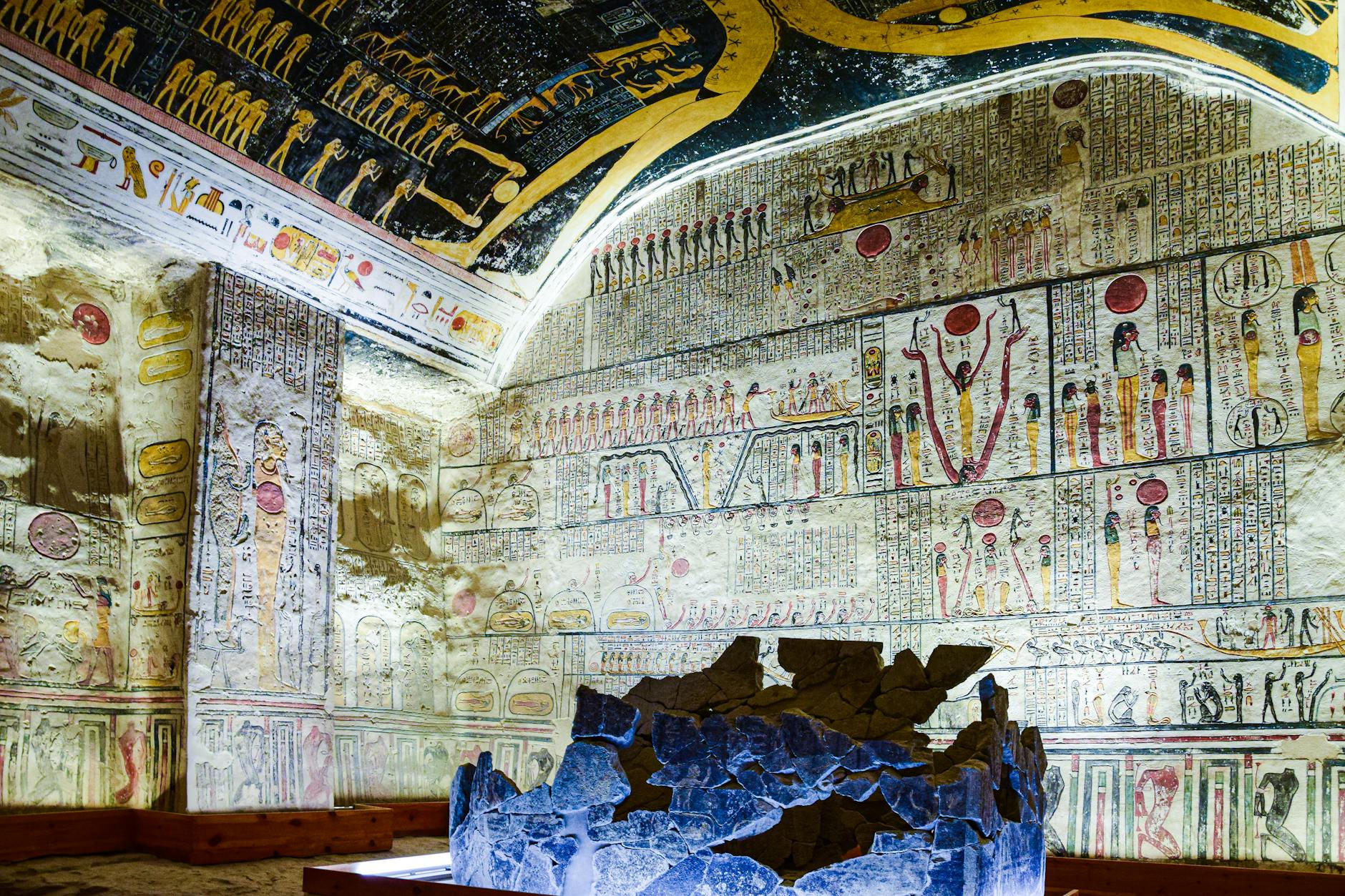
This is the tomb’s heart. Its walls show bright scenes of Tutankhamun’s journey to the afterlife. At the center stood his grand, gold-covered sarcophagus. Inside, four massive shrines nested like Russian dolls protected his mummy and treasures, keeping everything undisturbed for centuries.

Some of the most impressive objects from these chambers include:
- The golden throne with scenes of Tutankhamun and his queen
- Life-sized guardian statues, painted black and placed as eternal watchers
- Ornate alabaster perfume jars
- Jewelry boxes overflowing with bracelets, necklaces, and rings
Each room and each artifact paints a picture of how the ancient Egyptians honored their rulers and prepared them for an afterlife full of comfort and beauty.
The Golden Mask and Iconic Artifacts
Tutankhamun’s golden mask stands out as the most famous find. Shaped perfectly to fit the king’s face, it gleams with gold, inlaid glass, and colored stones. The mask did more than cover his face—it was meant to help his spirit recognize its body and continue living.
The mask’s details are stunning:
- Crafted from solid gold with blue glass inlays
- Intricate in its eyebrows and lined eyes
- Features a royal striped headcloth, inlaid with bright blue lapis lazuli
The mask holds deep cultural meaning. It shows the pharaoh's power, links him to the gods, and sets a standard for Egyptian art known worldwide.
But the treasures go far beyond the mask. Inside the tomb, Carter and his team uncovered:
- Enormous gold coffins: Three layered coffins held Tutankhamun’s mummy, each one more precious
- The canopic shrine: A golden chest with four smaller coffins, holding the king’s preserved organs
- Dazzling jewelry: Collars, pectorals, and rings, many with protective symbols or tiny portraits of gods
- Chariots and weapons: Real tools, not just ceremonial, hinting at the young king’s life and status
These objects are more than beautiful—they tell us about craftsmanship, beliefs, and daily life during Tutankhamun’s reign. The sheer mix of gold, artistry, and history makes his tomb the treasure trove of the ancient world.
The Life and Death of Tutankhamun
Tutankhamun will always be remembered as Egypt’s most famous boy king, but his life was short and filled with both mystery and change. Historians still discuss his family ties, brief rule, and the lingering puzzle of how he died. Here’s what we know about Tutankhamun’s story—both as a ruler and as a young man whose early death captured the world’s interest.
Tutankhamun’s Lineage and Reign: Summarize his family background, ascension, and role as pharaoh
Tutankhamun was born into Egypt’s 18th dynasty, a royal family marked by dramatic political and religious shifts. His father, Akhenaten, famously threw out Egypt’s old gods and focused worship on just one: the sun god Aten. Tutankhamun’s mother is believed to have been one of Akhenaten’s sisters, which was common practice for Egyptian royalty but may have led to health issues later on.
When Tutankhamun was around eight or nine years old, he became pharaoh. Egypt was experiencing major unrest. Akhenaten’s religious revolution had thrown the kingdom into chaos. People missed the old gods. Temples were left empty or destroyed.
Despite being so young, Tutankhamun’s time on the throne signaled a return to tradition. Some of his most important actions included:
- Reinstating Egypt’s old gods, like Amun.
- Repairing or rebuilding temples destroyed by his father’s rule.
- Moving the capital from Akhetaten (modern-day Amarna) back to Thebes.
- Relying on strong advisors: His most trusted were Ay (a high official) and Horemheb (a top military commander).
Tutankhamun married his half-sister Ankhesenamun. They tried to produce an heir, but all known children died before birth. His reign lasted just about nine years. He died as a teenager, leaving no surviving children. Even though he was not one of Egypt’s most powerful rulers, his tomb’s rich treasures made his name last for centuries.
Solving the Mystery of His Death: Discuss scientific investigations and prevailing theories, including injuries and possible health issues
Tutankhamun’s early death has fueled endless debate. Was it an accident, an illness, or something darker? Since the discovery of his mummy, researchers have turned to science for answers.
Egyptologists and scientists have used advanced technology to examine his remains, including:
- X-rays and CT scans of his bones and skull
- DNA testing for family links and genetic disorders
What have these studies revealed?
- Physical injuries:
Scans show a fracture in his left leg, likely an open wound just above the knee. Infection from this break could have been deadly. Some experts think he suffered this injury shortly before his death. - Head injuries:
Early X-rays suggested possible damage to the skull. Later research showed much of this came from mummification or later mishandling—not murder. - Genetic and health issues:
DNA analysis points to several health problems, possibly caused by inbreeding. Some scientists believe Tutankhamun had bone disease, scoliosis (curved spine), and a clubfoot. These would have left him frail and in pain. - Malaria:
DNA tests also detected malaria parasites. It’s possible he caught a severe form that combined with his injuries to end his life.
While older theories suggested assassination, most experts now agree Tutankhamun likely died from a mix of injury and illness. New clues still come to light as science advances, but his death remains one of history’s most lasting mysteries.
Legacy and Impact of the Tomb’s Discovery
The discovery of Tutankhamun’s tomb created a shockwave that stretched far beyond ancient history circles. The ripple effect touched pop culture, ignited worldwide Egyptomania, and transformed archaeological science. This section explores two key areas: the mysterious curse that haunted headlines and the profound shifts in how experts study and protect Egypt’s treasures.
The Curse of the Pharaohs: Touch on the legend of the curse and its effects on media and public intrigue
Stories of the “Curse of the Pharaohs” spread almost as soon as the tomb was opened. Newspapers from London to New York ran with dramatic headlines after Lord Carnarvon, the expedition’s financier, died just months into the excavation. Journalists played up folklore, claiming anyone who entered the tomb was doomed.
Of course, ancient Egyptians did write warnings on some tombs, threatening bad luck to anyone who dared disturb the dead. But no curse was carved on Tutankhamun’s burial chamber. Instead, much of the hysteria came from coincidence and the world’s love of mystery. The sudden deaths and illnesses among the team created a legend that stuck.
The legend of the curse inspired books, movies, and radio broadcasts. Highlights include:
- Sensational newspaper articles that boosted public fear
- Hollywood horror films featuring mummies and curses
- A surge in novels and short stories about Egypt’s secrets
- Board games, comic books, and even Halloween costumes
The story of the curse outlived its victims. Decades later, it still grabs attention, fueling documentaries and ghost stories that keep Tutankhamun in the spotlight. This mix of fear and fascination continues to draw crowds to museum exhibits, proving that mystery is as much a part of the tomb’s legacy as gold.
Influence on Modern Egyptology: Discuss advances in archaeological methods and conservation inspired by the discovery
Finding Tutankhamun’s tomb did more than uncover a treasure trove. It set new standards for how archaeologists work. Howard Carter’s patient, careful approach showed the value of recording every detail. He didn’t rush. Instead, he made lists, took photos, and drew maps to keep track of every artifact’s place in the tomb.
This discovery brought big changes in archaeology:
- Improved excavation techniques: Teams started to document objects more closely, avoiding the mistakes of previous digs where items were lost or damaged.
- Greater focus on conservation: The importance of preserving delicate items, like fabrics or wooden statues, became clear. New methods for stabilizing and repairing ancient objects were developed.
- International collaboration: Museums and scientists from different countries teamed up to study, conserve, and showcase Egyptian finds.
- Raising public awareness: Tutankhamun’s treasures drew massive crowds wherever they toured. This attention helped push for stronger protection laws for Egypt’s heritage sites.
Archaeologists also began using more advanced science. Microscopes, X-rays, and even DNA analysis are common tools now, thanks in part to interest driven by Tutankhamun’s tomb. The discovery set a bar for what careful, respectful archaeology could achieve—and showed that sometimes, what we learn from the process is as valuable as the treasures themselves.
The impact of Tutankhamun’s tomb will always go beyond the Valley of the Kings. Its legacy changed how the world sees ancient Egypt and how we preserve history for the future.
Conclusion
Tutankhamun’s tomb is more than a famous dig—it's a link to a world that feels both distant and strangely familiar. People from every corner of the globe still feel its pull, drawn by the gold, the art, and the mysteries that refuse to fade away. Its treasures laid out the story of a young king and the ancient beliefs that shaped a whole civilization.
The tomb keeps Egypt’s past alive. It inspires new studies, fuels museum displays, and sparks questions that keep us searching for answers. Whether you’re a history buff or just curious, Tutankhamun’s resting place proves that the past is never really gone.
Thank you for exploring this story. What part of Tutankhamun’s legacy do you find most fascinating? Share your thoughts or questions below and join the conversation.